The Vilification of Class Dojo and Other Ways To Avoid Taking Responsibility For Yourself

This is likely to be an unpopular post, much like my I'm Not Who You Think I Am post from 2010. The reason for its unpopularity will be that I am once again, going against the popular grain. Those of you who read this blog and/or who know me, know that I sometimes have a tendency to do that.
There's been a lot of talk lately about student data, privacy, "the cloud," FERPA, and classroom management. The latest "evil empire" to be held up as toxic to children is Class Dojo. Much like blaming cellphones for cheating on tests, social media for bullying, McDonald's for spilling our own coffee, and sugary soft drinks for our obesity problems, Class Dojo is being held responsible for punitive classroom management and violating FERPA. It doesn't matter that the TOS state that parental permission is required, schools and teachers apparently aren't to be trusted to read and abide by the TOS.
Is there anyone left who is willing to accept responsibility for his own actions?
In case you've been living under a rock, Class Dojo gives teachers an easy (and more fair) way to track student behaviors. It helps teachers spend more time teaching and less time on managing their classroom behaviors. I've been following Class Dojo since they won the Innovation Challenge at Education Nation in 2011. I was there in NYC at the event and it was very exciting to hear their pitch, participate in the vote, and see them win the $75K for them to startup. With Class Dojo, teachers decide what to track, what to share, whether the behaviors are positive or negative, etc. Once a teacher and class establishes a class set of rules, she can give points (or subtract points) as she is teaching without interrupting the flow of the lesson. This is similar to checks on the board, stickers on a chart, words of encouragement, pat on the back, wink of the eye, smile, etc. Understandably, people are concerned when it comes to 3rd party companies holding information on our students. Unfortunately, there has been some recent articles where Class Dojo was misrepresented, most recently a NY Times post where even the teachers quoted were mischaracterized. Class Dojo has responded admirably here and here.
While any tool in the wrong hands can be dangerous, I am still a firm believer in giving teachers some autonomy and subjectivity in running their classrooms. A well trained teacher will not be punitive and will use explanation, logical consequences, positive reinforcement, behavior tracking, and anything and everything to keep the flow of teaching and learning happening. It is not practical to think that every time a student does something that needs correction, a teacher will stop what she is doing and have a conversation with the child to the point that she understands what she did wrong and what she can do better next time. In an ideal world, yes that would be nice. But, in today's teaching world of too much curriculum to cover, not enough time, and trying to keep up with which students are in the classroom at any given moment, it is just not practical.
 |
| 1984 |
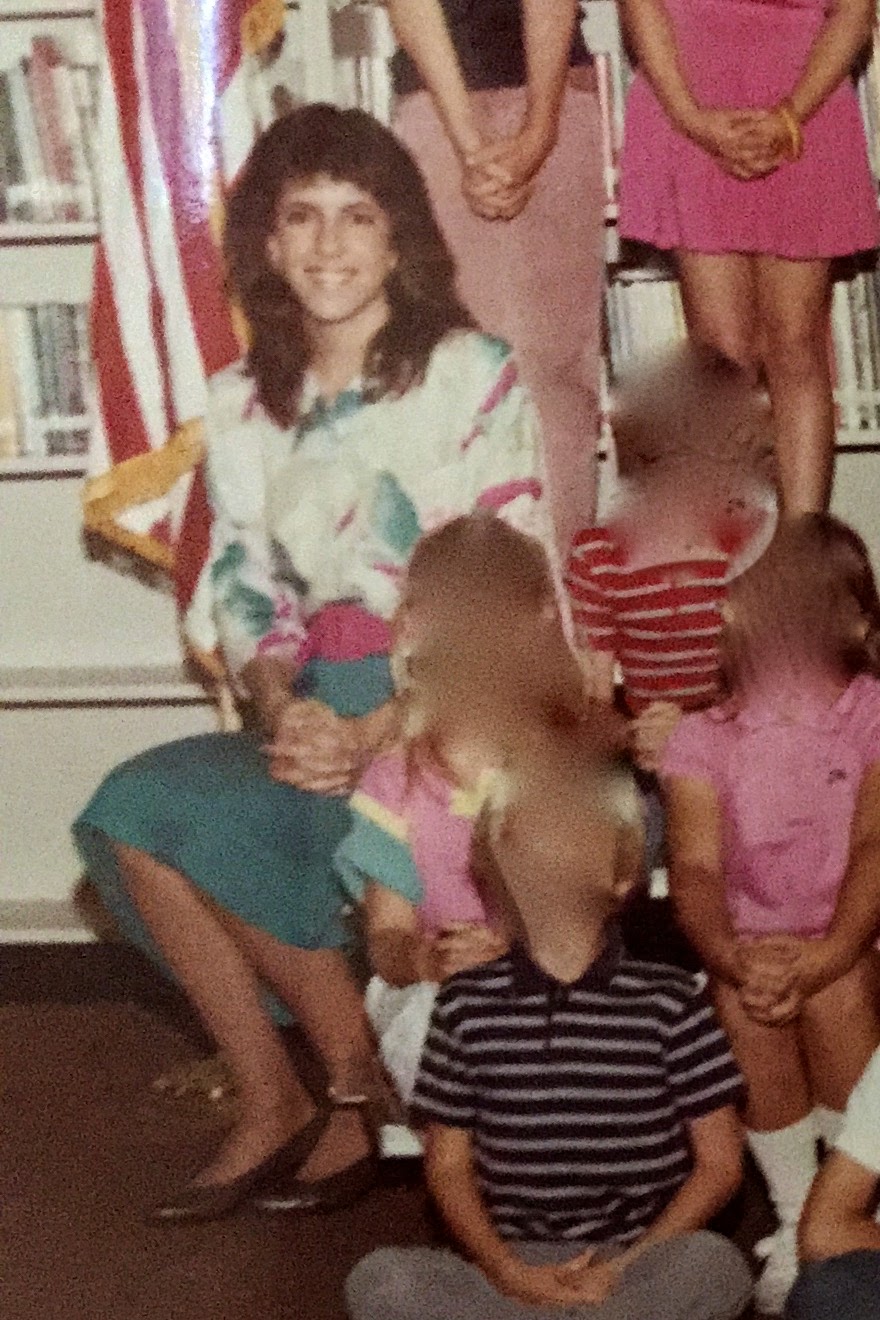
I began my teaching career in 1984. In my first year teaching, my first graders earned stickers to put on their cards. A full card at the end of the week earned a visit to the treasure chest. From there I learned to put checks on the board without interrupting the flow of the lesson, then clothes pins on a chart, and dolphins on a chart, and red yellow green cards on a street light, and so on. They all accomplished the same thing; I was able to let students know they needed to put the skids on what they were doing (they KNEW what they were doing was wrong) and they had some leeway before I got their parents involved. I still see my students today (as old as 36) and they appear to be happy, well adjusted adults, who are successful citizens who contribute to society. Although a few have landed in jail, I'm not sure I can specifically tie those results to their sticker cards. My students often tell me of their fond memories of our class. I've not received a single complaint, nor therapy bill due to damage caused by below sea level dolphins or red lights.
As for using Class Dojo for keeping parents informed of every little infraction, I would not do that. I would use it (privately) for classroom management and only reach out to parents as needed. Just as I had done since 1984. Students should not be worried that their parents are breathing down their necks and are going to question every mark. In many cases, that would be the case. For example, I would have a student constantly interrupting a lesson. After a few gentle reminders, the student would have to move her dolphin, or clothespin, or turn her card, or whatever. The student would get hysterical because she wouldn't want her parents to find out. If she knew her parents wouldn't find out unless she moved her dolphin two more times that day, it was a lot less stressful for her and she corrected her behavior the rest of the day. And the business of learning continued...
 Then, somewhere along the way, someone decided we shouldn't tell students they are doing anything wrong, so their cards should only stay on green, dolphins should only be above the water and sticker cards should always end up full. All kids should get an award. So, teachers started spending more time calling out students who were doing things RIGHT and ignoring students who were doing things WRONG for fear of violating FERPA. Problem was the students who were doing things wrong, weren't getting the message. They were just being ignored and were starting to hate the kids who were always doing things right. We've become a feel good society where we don't tell our kids anything that might make them feel badly about themselves.
Look at our youth sports teams. All kids play the same regardless of skill. Everyone gets a medal. I was cleaning out my kids' bedrooms (ages 24 and 21) and I asked them what I should throw away. My 24 year old told me I could throw away all the ice hockey trophies he won throughout the years, except for the ones where they actually won a championship. You see, getting a trophy for participating in the season doesn't mean anything to the kids either.
Then, someone decided that these systems violated FERPA, so they must be private. Other students must not be privy to the dolphin status, board checks, or how many stickers other students have. So, now the teachers do not publicly acknowledge students' behaviors right or wrong. Rather, they keep on teaching and if a student is disruptive, the teacher makes a private note and speaks to the student later on, in private. The other students MAY see the private conversation and surmise what it is about. Often, rumors will begin and circulate; rumors that are distortions of the truth. It would be unprofessional and against FERPA to clear the air.
Soon, more FERPA complaints ensue: Students raise their hands to answer questions in class, and some students get the answers right and some get them wrong, and all the students in the class are privy to that information. Some students finish their work more quickly than others, and students are privy to that information. A student leaves to go to the clinic, and other students are aware.
Have we gone too far? How long before this political correctness gets out of hand? I think we are dangerously close.
Some people have asked why we would use a behavior tracking system with students if we wouldn't use them with adults, for example in a faculty meeting or team meeting?
- There are a lot of things we do with children we don't do with adults. Children are works in progress. Children, for example, are expected to raise their hands to speak in class. We don't usually do this with adults.
- I think many people would actually welcome some behavior tracking in their work environment, if it were done privately. Negative behaviors are often discussed from an emotional point of view rather than a quantitative point of view. Wouldn't you welcome the opportunity to have a conversation about what you are doing right and what you could improve on?

We really need to take back parenting and teaching. We need to stop letting kids interrupt into adult conversations and asking their permission before we make adult decisions. I'm afraid we've created a generation of youth who do not understand their place in the world. They don't understand patience, respect, courtesy, manners, or authority.
What will it take to turn things around?